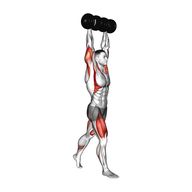
Overhead Bulgarian Split Squat
- Primary muscles
- Quads, Glutes
- Secondary muscles
- Hamstrings, Lower back, Shoulders
- Equipment
- Other
- Movement pattern
- Single Leg
Steps
- 1 Set up for a Bulgarian Split Squat by placing the top of one foot on a bench or elevated surface behind you.
- 2 Position your front foot far enough forward so your knee will not extend past your toes when you squat.
- 3 Hold a dumbbell, kettlebell, or barbell with both hands, extending your arms fully overhead.
- 4 Keep your core tight, chest up, and gaze forward to maintain balance.
- 5 Begin the movement by bending both knees, lowering your back knee towards the floor.
- 6 Descend until your front thigh is roughly parallel to the ground, ensuring your front knee tracks over your toes.
- 7 Throughout the squat, maintain the weight directly overhead with straight arms and engaged shoulders.
- 8 Drive through the heel of your front foot to push yourself back up to the starting position.
- 9 Keep your core braced and the weight stable overhead until you complete the repetition.
- 10 Complete all desired repetitions on one leg before carefully switching to the other leg.