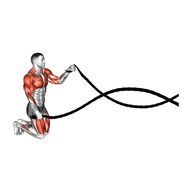
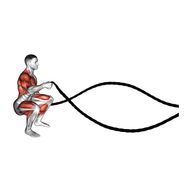
Battle Rope Alternating Lunge Wave
Muscle Groups: Shoulders, Biceps, Triceps, Forearm, Quads
Battle Rope Alternating Lunge Wave focuses on Shoulders, Biceps, Triceps, Forearm, Quads, with Abs, Glutes, Calves, Lower Back, Hamstrings working as supporting muscles.
How to Perform
Follow these step-by-step instructions to perform Battle Rope Alternating Lunge Wave with proper form and technique.
- 1
Stand facing the rope anchor point, holding one end of the battle rope in each hand with an overhand grip.
- 2
Position your feet hip-width apart with a slight bend in your knees, keeping your core engaged.
- 3
Step your right leg back into a reverse lunge, lowering your hips until both knees are bent at about 90 degrees.
- 4
As you lunge, simultaneously begin to create alternating waves in the ropes by driving one arm up and then down forcefully, followed immediately by the other arm.
- 5
Maintain this continuous alternating wave motion with your arms as you push off your right foot to return to the standing position.
- 6
Immediately step your left leg back into a reverse lunge, continuing the alternating rope waves throughout the movement.
- 7
Push off your left foot to return to the standing position, still maintaining the continuous alternating rope waves.
- 8
Continue alternating lunges and rope waves for the desired duration or repetitions.
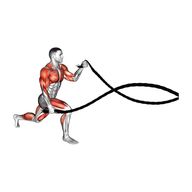
Secondary Muscles
While Battle Rope Alternating Lunge Wave primarily targets Shoulders, Biceps, Triceps, Forearm, Quads , this exercise also activates several secondary muscle groups during the movement. These supporting muscles include Abs, Glutes, Calves, Lower Back, Hamstrings . Engaging these secondary muscles helps stabilize your body throughout the exercise, improves overall coordination, and contributes to balanced muscle development.
Related Exercises
If you enjoyed Battle Rope Alternating Lunge Wave, you might also want to try these related exercises that target similar muscle groups.
These exercises work the same primary muscles as Battle Rope Alternating Lunge Wave, making them excellent alternatives for variety in your training program or complementary movements to include in the same workout session. Mixing different exercises that target similar muscle groups helps prevent plateaus, reduces overuse injuries, and keeps your workouts engaging and effective.
Battle Rope Alternating Jump Wave
Muscle Group: Shoulders, Biceps, Triceps, Forearm, Quads
Battle Rope Alternating Kneeling to Standing Wave
Muscle Group: Shoulders, Biceps, Triceps, Forearm, Quads
Battle Rope Alternating Wave with Lateral Shuffle
Muscle Group: Shoulders, Biceps, Triceps, Forearm, Quads